|
Island Industries Board, Thursday Island, Torres Strait
I lived and worked on Thursday Island in 1977 for a short few months
before this run-away train called life took me away on a white-knuckled ride through
half-a-dozen more countries and some twenty-or-more work assignments.
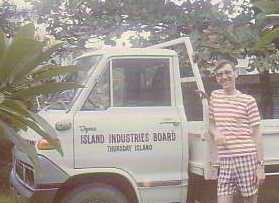
I worked as accountant for the Island Industries Board under the management of the crotchety old
Cecil Burgess.
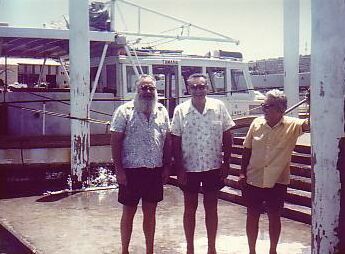 [P.S. I have since been able to make email contact with a very nice lady by the name of Nola
who works for the Council on TI. She knows the people I have known and
tells me that the Fulwoods now live in Mackay and Roly in Cairns, "Canadian Jim" is now in his
80s and lives on Horn Island ("Canadian Jim" liked his drink and it wasn't
"Canada Dry" and I am surprised his liver held out this long -
his "shadow" Ron Taylor retired from IIB in 2001 and moved to Cairns where
passed away in 2003),
and Brian Pearson (who "inherited" my dog Snoopy when I left the island) and his wife Sara still live on TI where
he drives a taxi. Brian, you've got yourself a fare for Sunday the 24th of April!
- maybe even longer as I am seriously considering staying over on the island
and taking the same boat back when it returns a week later. Nola also mentioned that
David Richardson's shack at Country Women's Beach on Prince-of-Wales Island was bought
by her brother many years ago, that the huge cyclone-proof shed which Yvonne, the hairdresser,
and her husband built at Bluefish Point was later moved to the main beach now called
Muralug and that somebody else, "Maori George", now lives in it,
[P.S. I have since been able to make email contact with a very nice lady by the name of Nola
who works for the Council on TI. She knows the people I have known and
tells me that the Fulwoods now live in Mackay and Roly in Cairns, "Canadian Jim" is now in his
80s and lives on Horn Island ("Canadian Jim" liked his drink and it wasn't
"Canada Dry" and I am surprised his liver held out this long -
his "shadow" Ron Taylor retired from IIB in 2001 and moved to Cairns where
passed away in 2003),
and Brian Pearson (who "inherited" my dog Snoopy when I left the island) and his wife Sara still live on TI where
he drives a taxi. Brian, you've got yourself a fare for Sunday the 24th of April!
- maybe even longer as I am seriously considering staying over on the island
and taking the same boat back when it returns a week later. Nola also mentioned that
David Richardson's shack at Country Women's Beach on Prince-of-Wales Island was bought
by her brother many years ago, that the huge cyclone-proof shed which Yvonne, the hairdresser,
and her husband built at Bluefish Point was later moved to the main beach now called
Muralug and that somebody else, "Maori George", now lives in it,
 and that
Gwen Maloney, the publisher of the "TORRES NEWS", the island's weekly newspaper
(or, as we called it, the 'Birthday Book' as it dealt mainly with people's personal affairs),
passed away last year. She had sold the "Torres News" some fifteen years ago to another lady who in turn
resold it to Mark Bousen two-and-a-half years ago. Mark tells me that I won't recognise
the newspaper anymore which is now a full-colour, weekly tabloid publication with a
circulation of 3000.
So, as Nola puts it, nothing stays the same forever, not even on TI, except perhaps the
island's main street which still "is a ghost town on a Sunday."]
and that
Gwen Maloney, the publisher of the "TORRES NEWS", the island's weekly newspaper
(or, as we called it, the 'Birthday Book' as it dealt mainly with people's personal affairs),
passed away last year. She had sold the "Torres News" some fifteen years ago to another lady who in turn
resold it to Mark Bousen two-and-a-half years ago. Mark tells me that I won't recognise
the newspaper anymore which is now a full-colour, weekly tabloid publication with a
circulation of 3000.
So, as Nola puts it, nothing stays the same forever, not even on TI, except perhaps the
island's main street which still "is a ghost town on a Sunday."]
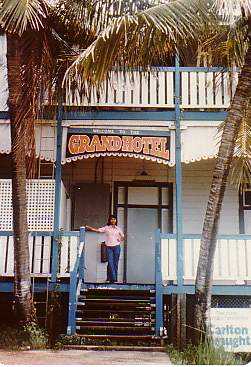 Some things will have changed on
Old T.I.:
for instance, the Grand Hotel - renowned as "the pub where Somerset Maugham stayed",
burnt down in 1993. The Grand was famed in the Torres Strait as a watering
hole and resting place for pearlers, fishermen and travelling sales representatives. Maugham
slept and wrote at the rambling 102-year-old hotel at least once, in 1921, when he complained
about its kitchen's tendency to produce turtle soup "so often that I have ceased to look
upon it as a luxury". The British author described his arrival at the hotel in
'French Joe', a short
story he apparently wrote - along with another,
'German Harry' -
while staying at the Grand.
(If I were a writing man, I could add my own stories about
Cec Burgess and "Canadian Jim", to name just two.)
Of course, back in 1977
I still had my head firmly buried in accountancy text books and had neither heard of Somerset Maugham
nor read his stories which makes this trip almost thirty years later all the more poignant.
Some things will have changed on
Old T.I.:
for instance, the Grand Hotel - renowned as "the pub where Somerset Maugham stayed",
burnt down in 1993. The Grand was famed in the Torres Strait as a watering
hole and resting place for pearlers, fishermen and travelling sales representatives. Maugham
slept and wrote at the rambling 102-year-old hotel at least once, in 1921, when he complained
about its kitchen's tendency to produce turtle soup "so often that I have ceased to look
upon it as a luxury". The British author described his arrival at the hotel in
'French Joe', a short
story he apparently wrote - along with another,
'German Harry' -
while staying at the Grand.
(If I were a writing man, I could add my own stories about
Cec Burgess and "Canadian Jim", to name just two.)
Of course, back in 1977
I still had my head firmly buried in accountancy text books and had neither heard of Somerset Maugham
nor read his stories which makes this trip almost thirty years later all the more poignant.
 When I lived and worked on the island,
the Grand's dining room had been crammed with souvenirs
When I lived and worked on the island,
the Grand's dining room had been crammed with souvenirs
 of the Torres Strait's maritime history,
but early on the 5th of March, 1993
all was destroyed in a blaze which began about 4am and
swept through the timber building in less than an hour, forcing the evacuation of 12 people
and causing about $2 million damage. No one was injured but together with the then licensee,
Mr Norm Shadbolt, the whole island mourned the enormous loss of history.
of the Torres Strait's maritime history,
but early on the 5th of March, 1993
all was destroyed in a blaze which began about 4am and
swept through the timber building in less than an hour, forcing the evacuation of 12 people
and causing about $2 million damage. No one was injured but together with the then licensee,
Mr Norm Shadbolt, the whole island mourned the enormous loss of history.
Thursday Island - also known as the "Thirsty Island" - has always been well
endowed with hotels and its lusty frontier town atmosphere has meant they have usually
done well. Apart from the Grand Hotel, the
Federal,
Torres, Royal, Imperial, and Metropole
have been witness to much that characterises boom economic growth. However, the
Imperial and the Metropole no longer exist.
T.I. has also seen the intrepid yachtsman Joshua Slocum, the famous German warship the
"Emden," Tarzan of the North Michael Fomenko and more recently the Danish
adventurer Hans Tholstrup.
Magical powers of a local tree are also claimed. The Wongai is a native tree of the
Torres Strait bearing a small fruit similar to a plum which is eaten ripe or dried.
The seed is used in Island jewellery and the timber is excellent for woodcarving.
Perhaps the most famous Wongai on T.I. was one located in front of the Federal Hotel
which was planted about 1900 and blown over by cyclone "Otto" in February
1977. The local legend claims that if you eat the fruit of the Wongai you are destined
to return.
T.I. has witnessed many changes in its
history but perhaps the greatest influence
has come from the discovery of pearl shell in the 1860s. This industry provided employment
for many islanders and was responsible for the influx of foreigners to T.I. especially
the Japanese. Pearl shelling boomed until the immediate post-war years when the industry
entered a depressed state. Australian and Japanese interests established several cultured
pearl farms in the early 1960s and pearling has continued in this form until the present
day. At my time on T.I., the Island Industries Board still maintained a pearl store on
Victoria Parade and shipped out a small amount of pearl shell. Tom Fujii, the last of the
Japanese deep-sea pearl divers, was still alive then and an article headlined,
"Fujii, last of the men
who dived with death", appeared on 31st March 1977 in "The Australian" in memory of Tom
and the other 6000-odd young Japanese imported into the Torres Strait between the 1870s and 1940.
|

